
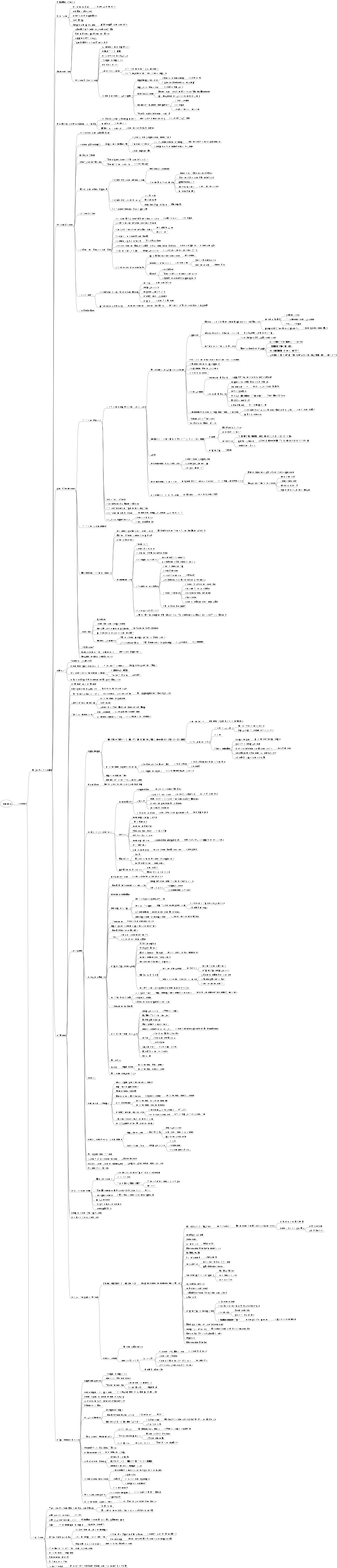
Карта категорий проекта



Декабрь 2016
DiClemente, Carlo C., Scott K. Fairhurst, and Nancy A. Piotrowski. 1995. “Self-Efficacy and Addictive Behaviors.” In Self-Efficacy, Adaptation, and Adjustment: Theory, Research, and Application, edited by James E. Maddux, 109–41. Boston, MA: Springer US. http://dx.doi.org/10.1007/978-1-4419-6868-5_4.
The experience of the self as drunk
In this section we examine how Alison presents her engagement with alcohol as an experience of flux, oscillation and instability. We introduce the analysis with an extract which presents some of the main features of Alison’s engagement with alcohol. It also vividly illustrates how Alison turns to metaphors to describe her experience, a feature frequently repeated during the interview:
Some big wave, you know, you just get caught with it, that’s what it used to be like, this kind of like helpless feeling, just having to go and get drunk almost, you know, not even particularly wanting to, just feeling like there’s no other way when you are in that situation.
Sinha, Rajita. 2009. “Modeling stress and drug craving in the laboratory: implications for addiction treatment development.” Addiction biology 14 (1): 84–98. doi:10.1111/j.1369-1600.2008.00134.x.
Альберт Бандура выделяет в структуре human agency три основные подструктуры. Прежде всего мы должны иметь мотив, чтобы что то сделать. Во вторых необходимы знания как прийти к результату и наконец каждой акции присуще то, что в психологии называется аффектом. Здесь мы его просто обозначим как то, что выходит за пределы строгой рациональности. Это прежде всего эмоции, переживания и даже такие романтические вещи как надежды, смелость или душевные порывы. Все эти вещи, которые мы перечислили выше отличаются той замечательной характеристикой, что любая серьезная наука моментально тушуются при попытке дать точное определение этим словам. Действительно аффективные состояния это когда мы больше чуствуем чем понимаем